Monday, December 6, 2010

Wearing Multiple Hats


One of the parts of my job that I have the most fun with is doing the public address for most of our home athletics events. While I have been the sports information director at Pacific University since 1999, I have been doing P.A. for home volleyball and basketball games since 1994. Since becoming SID in 1999, I have also picked up announcing duties for soccer, wrestling, track and field, swimming, baseball, softball and women's lacrosse.


When I am pulling double duty as SID and PA announcer, it can sometimes be a delicate balance. If there is an issue with the table, do I keep doing PA and let my students work it out, or do I go help resolve the situation? If I am short on student workers, what do I let go of first or can I handle two or three jobs at once? I know that in the world of the small college sports information directors, this is hardly unusual.


What follows is an article that I was asked to write for the newsletter of the National Association of Sports Public Address Announcers (NASPAA), an organization devoted to developing training and professionalism for sports PA announcers nationwide. This appeared in the December 2010 issue.


It is 15 minutes before the start of another Pacific University volleyball match, but this time I am in a bit of a panic.


Earlier in the day, I realized that one of my main statisticians had a class conflict and would not be able to work that night. Then, 30 minutes before the match, our scheduled libero tracker calls in sick.


As Pacific sports information director and event manager, this means that I have to pick up another duty for the evening along with my usual public address duties. On this night, I moved the microphone and announced as I tracked substitutions and the libero’s movement. In both the eyes of the fans and the officials, I was able to do it seamlessly.


For many of us in sports information at the small college level, wearing multiple hats is all part of the job. While I prefer to focus solely on the PA and let my student workers handle the rest, there are times that I have to do multiple jobs just to keep the game moving. In my 12 years at Pacific, I have juggled public address with volleyball scoring and libero tracking, basketball scoring, baseball/softball scoring, run scoreboard and even spotting and inputting for our official stats.

In some cases, multitasking is just part of the job. It is easy enough to score a baseball or softball game and do the PA simultaneously, but doing it during a volleyball or basketball game can be a challenge that requires a lot of focus. I know some colleagues who do this on a regular basis and do it flawlessly. My hats are off to them.


If you are faced with a situation where you have to pick up a second duty in addition to public address duties, it helps to keep things in perspective and understand where your priorities have to be. Consider these tips if you find yourself in such a situation…


KNOW YOUR LIMITS: Take into consideration the task you are being asked to add and decide if you enough hands or enough concentration to take it on. If the answer is no, do not be shy to tell the event manager “no” or to make the manager choose between the additional task and the PA.


MAKE THE OFFICIALS AWARE: When I take on an additional duty, I always make sure the officials are aware of the situation. This will but some understanding from the officials, as they want the game to follow smooth as much as you do.


KNOW YOUR PRIORITIES: This may not be a welcome thought for the PA professionals reading this publication, but there are times when another essential game duty is more important than the public address. If you have to score a game or assist with stats while doing PA, the book or the computer has to come first. The PA announcement must become secondary.


The same is true for any additional duty key to the flow of the game. Even when I have a full crew, I sometimes have to step in and troubleshoot for my stat crew or remedy another problem. I may miss an announcement or two, but that will save me much more time after the game if I wait until later to fix it.


It is possible to pull double duty as a public address professional, but it requires more concentration that you might think. Take the time to consider if you are up to the task, and know when it’s too much. And know that those who do aren’t any less the public address professional. They are just doing what they can to get the job done.

Monday, June 15, 2009

Media Guides...The Fond Farewell

It is curious that one of the big things that drew me to this business is the thing that could have driven me away from it.

From the time I started at Pacific in 1999, I have thrived on the media guide. I have loved the concept of taking a program’s history, rebuilding it, shaping it into a tangible form and producing a publication that is nothing short of an advanced placement history book for Boxer athletics.

But there is some truth to the saying that if you love something, you have to let it go. And I have reached that point. For the 2009-10 year, I will not produce a single media guide. A bittersweet decision, certainly.

From the view of our coaches, the media guides are great pieces; something that not many other schools at our level do now. But the fact of the matter is that eight of our 20 teams (cross country, track and field, tennis and golf) didn’t have one. Those coaches made their displeasure heard, but also agreed that the time isn’t there for me to add four more publications.

For me, the decision not to do them is partly a matter of relevance. The printed media guide is quickly becoming a dinosaur. Fewer and fewer small colleges (non Division I) are producing guides. While some had reduced their guides to high profile sports like football and basketball, many more have stopped producing them altogether. It’s just as easy to get all of the information of the ever-growing World Wide Web.

A number of Division I schools have stopped print guides altogether. There is potential NCAA legislation that would eliminate all media guides at the Division I level. So, in a way, we’re keeping up with the Joneses.

There’s also the question of purpose. Media guides are meant to be for serving the media that cover our teams on a regular basis. However, I can count on one hand how many members of the media have been around to cover Pacific athletics. The bulk of the guides are used by our coaches as another item to help lure the prospective player to choose Pacific over another school.

The upside of that is the opportunity to hand an impressionable 17-year-old a glossy, high quality publication focused on a specific program. The down side is that the guide tells the whole story, good, bad or indifferent. Not the best piece of recruiting swag if you are coming off a 5-20 season.

So the guides are gone, replaced by a series of tri-fold, full color recruiting brochures that will serve all of our sports and show the brighter, positive side of Pacific athletics.

The challenge of designing and developing these recruiting brochures will be exciting, but it won’t be same as the challenge and thrill of developing a strong, high quality, award winning media guide. And believe me, I will miss it.

The media guide challenge that put all of my skills to the test, and one that I passed with flying colors. It was a self challenge of doing something better than Pacific had ever had before.

As an athlete at Pacific, the “media guide” was nothing more than a four-page game program whose layout was basic at best. Head shots, name, hometown, previous school, position. If there was room, maybe a season preview. Oh, you run cross country or play tennis? Forget it…only teams with true home events and home crowds.

My direct predecessor as sports information director at Pacific (who lasted all of six months) raised the bar, creating the first true media guides for Pacific in nearly a decade. There was the combined fall sports piece that tied together men’s & women’s soccer, volleyball and cross country. Men’s basketball, women’s basketball and wrestling all had their own pieces, as did baseball and softball in the spring.

The guides were basic at best. No more than 12 pages for any one sport (which was all that the budget would allow) and 20 pages for the combined fall piece.

In my first year, the guides expanded to allow for records for specific sports where they were already compiled. The largest guide – 24 pages for the combined fall sports piece.

Fast forward to 2008-09. The Pacific sports information office (also known as me) produced a total of 10 media guides, all with full color covers. The smallest guide, women’s lacrosse, spans 32 pages. The largest, the two soccer guides and the wrestling guide, ran 40 pages each.

It has been a labor of love me and one that has paid dividends. In the last five years, my guides have won 28 CoSIDA Publication Contest awards. That includes eight guides deemed “Best In The Nation,” the gold standard when it comes to media guides. Three of those awards have come this year alone for women’s lacrosse, softball and wrestling. In addition, my guides have also received awards from USA Volleyball, Swimming World Magazine and Amateur Wrestling News.

There is nothing like awards to drive you to raise the bar and strive and do more and better work. But it comes at a price, and that is when push came to shove.

To put together a quality media guide, it takes me 30-40 hours per guide. That includes the typesetting, sizing and manipulating photos, compiling biographies, updating records and developing cover concepts.

Add that up….30 to 40 hours per week adds up to almost three work months spent exclusively on media guides. That much dedication meant that other things suffered to make sure that the guides not only came close to meeting deadline, but lived up the quality that others expected and that I expected of myself.

In the past, I would take some of that work home. That was before I had two wonderful daughters that deserved my attention and a wonderful wife that not only deserved my attention, but also a break. For the first time ever, media guide work didn’t go home. And to be honest, quality suffered a bit.

I love the media guides, but I love my family more.

Parts of the media guides will live on as the records section of the guides move online as purely a record book. The update process will take much shorter amount of time, but there will be no printed version. There will be no awards to be earned, no books to hand out to media, parents and prospectives. Just a tri-fold brochure and a PDF.

Will media guides return? Perhaps. Outside of a football guide, we won’t be bringing the guides back unless I get some full-time help in the office. Its too much to put on the shoulders of just one person. And as much as I love earning the honors and accolades and like the idea of that ever expanding AP history book, its time to change with our digital, short attention span theater times.

To view some of my media guide work, visit the individual pages at www.goboxers.com.

Thursday, May 7, 2009

33 Years And Getting Younger

I gave myself a cool gift for my 33rd birthday. I went out and ran six miles.

Not your idea of a cool gift? Well consider this. It has been a long time since I have run that kind of distance. Can't remember the last time. With my past two injury problems, the wheels have always come off at five miles.

The sun come out around the lunch hour and I headed out on a loop that I know well, but haven't run on for at least five years. The shoulders along Stringtown Rd., west of Forest Grove, are minimal at best, but the lack of car traffic makes it ideal. Not much activity going on other than the action at the surrounding nurseries and the occasional person working in their yard.

It was nice. I moved along at what felt like a smooth pace, determined to go farther than I have in a while. I didn't really start feeling things until I got off B Street and headed towards Main St. The legs kept pumping, but it was obvious that they were working hard.

I came through at 46:03. A pace of around 7:55 per mile, which is faster than I wanted. Even though I should be running the longer runs more slowly (want to keep any injuries from flaing back up), I smiled. My fitness is improving, and it shows.

Hopefully I am not jinxing myself, but it feels good to be back. Thirty-three is not old at all, but this body has taken its share of injuries. I certainly don't want to revisit any of those by doing too much, too fast. I want to keep getting younger and getting faster. The journey has been good so far. I think its only going to get better.

I was on a great streak with my running until the end of March when the job and a chance to work the NCAA Division I Men's Basketball Tournament stunted things a bit. I am just now getting back to where things are feeling easy and I have that desire, that taste to hit the roads. It feels great. Gotta keep it going.

It was a birthday gift and a birthday challenge. How did you challenge yourself on your birthday?

Tuesday, January 13, 2009

More Coming Soon

People who read this (all 4 or 5 of you) have noticed that I have not updated this blog since September. To be honest, my blogging has almost all been work related and been posted on the Boxer Blog, which is the blog on my Pacific University Athletics page.

Look for me to add a few entries here soon. Have some things to get off of my mind...

Monday, September 22, 2008

The End Of The World As We Know It

All you need to know is what you see in the following video of clip of our six-month old Hannah, who has learned the fine art of putting one hand and knee in front of the other...


Monday, August 25, 2008

Sleepless Nights

It has become almost a ritual for me...nights of interrupted sleep leading up to the first week of sports competition at Pacific University.

Hence, here I am at 12:40 in the morning, downing a cup of "Sleepy Time Tea," hoping to get my brain to settle down enough to get a few hours sleep before heading into the office to begin two of the more hectic weeks of my year.

What makes it hectic? First there are the tasks to complete before the start of every individual sports season: compiling rosters, writing player bios, posting said rosters and bios to the Web site, writing season previews, posting said preview to Web site, writing the first notebook releases of the season, weekend game programs.

Then there is bringing my crew of Work Study students up to speed. I have a span of four days to hire and train a crew of 10-12 students who will be my backbone during all of our home events: scorekeepers, statisticans, scoreboard operators, clock operators. This will include at least a pair of evening training sessions and some one-on-one time with specific people, such as our volleyball stats crew.

The training is to prep those hard working students for a long first weekend. We host a two-day, seven-team volleyball tournament this weekend. Seven matches each day, including two matches each at 10 a.m. and 1 p.m. It stretches my crew thin when everything needs to run flawlessly.

On top of that this year is a new addition: a women's soccer doubleheader on Friday and two more games on Sunday running concurrently with the volleyball tournament. I will probably have to hire outside for at least one person. It is a cruel way for a one-man sports information office to start the year.

Then there are the media guides. Three 40-page publications documenting the men's soccer, women's soccer and volleyball seasons. Thankfully I was able to get the majority of the work on these done before this week came. That leaves the player bios, season previews and team photos.

Those items, however, are partly at the mercy of the coaches and how important they think it is to get the information they need to me in a timely fashion. For some, the idea of writing 2 sentences about what each of their athletes will contribute to the team is too daunting. Scheduling team pictures is easy...provided we can sync up everyone's class schedule and not take any time away from practice.

So, here I am in front of the computer. The plea for student workers has been submitted to the daily student e-newsletter and the plea for volunteers has been submitted to the staff e-newsletter. The cup of tea is almost empty. Hopefully my mind can stop racing and preserve some cells for Monday. I will need them.

Oh...and there's meeting with the advertiser who I need to get a decent chunk of my operating budget from. Better have the game face on.

Sunday, August 24, 2008

Beijing 2008

Some of the impressions from the Games of the XXIX Olympiad that will stick with me...

• Michael Phelps is an absolute stud. Swimming is one tough thing to do (this from a runner who can last one workout in the pool). To have the strength, the resolve and the focus do pull off what he did, with all of the different disciplines, is truly amazing. I would compare it to an individual track athlete winning the 100, 200, 400 and the long jump and then helping win the two relays.

And Phelps did it with unbridled excitement. At the end of each race, each time he stood on the top of the medal podium, he was excited to be there and, quite possibly, in awe of his own feat. Eight races. Eight golds. Seven records. Wow.

• Usain Bolt is an absolute stud. World records in the 100 and 200 at the same Olympics, a feat never before equalled. (Jesse Owens did set records in the 100 and 200 in the 1935 Big 10 Championships, but he couldn't repeat that in Berlin.) Add to that the world record in the 4x100-meter relay. But then...one would expect a record when the current 100m world record holder hands off to the former record holder (Asafa Powell). My only regret: seeing what he could have done had he not pulled up at the end of the 100. Possibly a sub-9.60? I have a feeling we will know in the future.

• The United States as a whole was quite disappointing in the Bird's Nest. Tyson Gay's no show to the 100-meter final (though I will give him the benefit of the doubt with the hamstring injury he suffered in the Olympic Trials). Bernard Lagat failing to medal in either the 1,500 or 5,000. The botched handoffs by both of the 4x100-meter relays. The absence of Reese Hoffa on the medal stand in the shot put (offset by the silver medal performance of Christian Cantwell). Lolo Jones striking the last hurdle in the 100-meter hurdles and failing to medal. The U.S. has some serious ground to make up over the next four years leading up to London.

• On the positive side for USA Track & Field: The 1-2-3 sweep in the men's 400 meters, the domination by both 4x400-meter relay teams, Bryan Clay's gold medal in the decathlon (join the likes of Dan O'Brien, Bruce Jenner, Bob Mathias and Jim Thorpe as Americans to earn the title World's Greatest Athlete), Hyleas Fountain's silver medal in the heptathlon.

• I could not be happier for Walter Dix. The former Florida State sprinter was one of the nicer and fresher personalities at the Olympic Trials and came home with broze medals in both the 100 and 200. He has the potential to be a force in world sprinting in the next four years.

• Note to Great Britain: Although you did best Jamaica in the finals of the men's 4x400-meter relay, the last thing you want to do is taunt the world's greatest sprinting power in a preliminary heat. Bad idea.

• As much as I love watching long distance running, I don't think I needed to see the men's marathon in its entirety in prime time (though I will admit that my dad and I spent a Saturday night on the couch, eating pizza, watching the Kenyans earn their first gold medal in the event).

• The Redeem Team lived up to it's name, playing like a team and showing the world that, although they are catching up, it is still the United States' game. And the callsy move for the team photo of putting all the gold medals around Coach K's neck (remember that the coaches do not receive medals).

• Every four years, I will watch sports that I would normally have no interest in whatsoever: weightlifting, air pistol shooting, badminton, water polo, gymnastics, kayaking, rowing, boxing. And it looks even better in HD.

• China won the race in gold medals, but will the sports machine they have created be as concerned about it now that the Chinese games are over?

• I am looking forward to what kind of a show London can put on. Beijing set the bar very high.

• If anyone can get me tickets for men's hockey or speed skating for Vancouver 2010, let me know!

Sunday, August 3, 2008

The Oklahoma City Coopers?


Many in the Emerald City are still fuming over the Supersonic's departure to Oklahoma City thanks to Clay Bennett after his less-than-disguised attempt to make people think that he ever intended to keep the team in Seattle.

Paul Lukas, who write a sports uniform column on ESPN.com's Page 2, challenged readers to come up with their own designs for the yet-to-be-named Oklahoma City team. The designs ranged from ingenious and well designed to downright ugly.

Then...there were the sour grapes awards, no doubt entered by Seattleites who would love a piece of Bennett's hide. There is the Franchise Stealers, complete with prison stripes for the road uniform, and the Vultures, among others. I love the Coopers, a less-than-subtle nod to the Northwest legend who jumped out of a commerical passenger plane in the late 1970s with several thousand dollars, never to resurface. Much like the Sonics.

Click Here To View A Gallery Of All Of The Submitted Designs

Thursday, July 10, 2008

Add Olympic Trials Wrap

Ron Bellamy, sports editor of the Eugene Register-Guard, had a great column about Eugene's performance with the Olympic Trials and the resurgence of Track Town USA.

Read The Column Here

Wednesday, July 9, 2008

Olympic Trials Wrap: Moments & Legacy

It's now been three days since the U.S. Olympic Track & Field Trials wrapped up in Eugene, and I think I have finally come down off of the high. The adrenaline rush and sleep change definitely caught up Monday. It took me a few cups of coffee to keep me going.

The trials were by far the most exhilirating and most exciting sporting event I have ever been a part of. I sat through all eight days absolutely riveted. There aren't many venues where you can see the world's greatest athletes on the same stage, competing for the right to represent their country for their sport's highest prize. As a track fan, it doesn't get much better.

Even still, eight days is a long time for anything, and I was happy to come back home to my home, to my wife and children and my own bed (dorm room mattresses haven't changed...they're still rock hard).

There are plenty of moments that will stay with me through the years. Here are some examples.

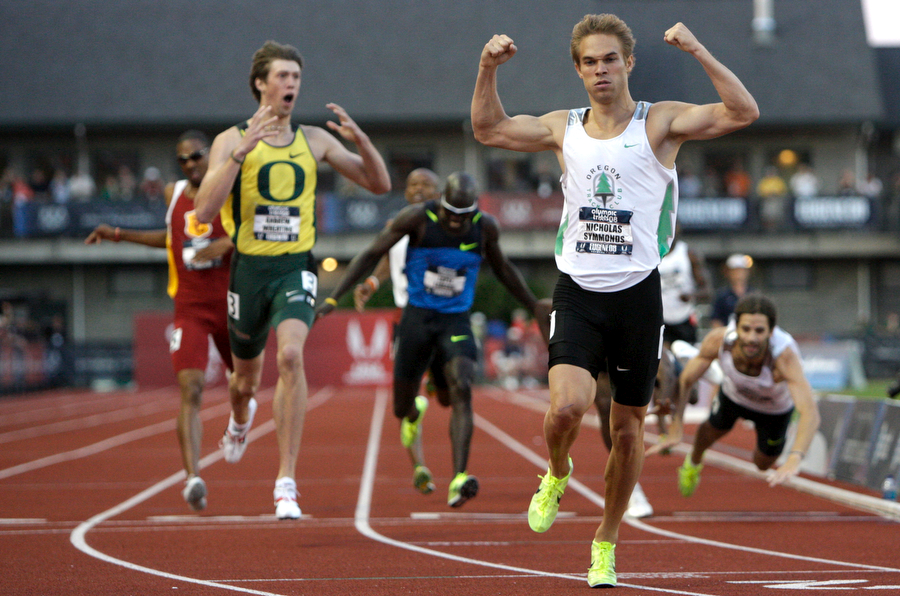
BEST OVERALL MOMENT: The men's 800-meter final. You would swear that Prefontaine himself had stepped back on the track. The buzz in the stands was absolutely electric as the finalists warmed up on the track, and it only heightened when Nick Symmonds and Andrew Wheating were introduced. With 500 meters to go, the entire crowd (press row and all) moved to its feet and din't leave there for another 10 minutes. The roaring crowd only got more deafening when Symmonds moved to the lead out a boxed-in spot in lane 1 with 150 meters to go, and even louder when Wheating moved up on the outside to finish second and become an unexpected Olympian. It was so loud that you could not hear yourself yelling. Some compared those 20,000 fans to the loud crowds at Autzen or those at Mac Court when UCLA comes to visit.

Perhaps even more priceless was the picture nobody saw. Everyone has seen the shot of Symmonds with his hands raised crossing the finish line while a shocked Wheating comes across with mouth wide open. What few have seen is that when the scoreboard flashed that Wheating had indeed placed second, Symmonds' jaw dropped equally as wide while he searched out the man in the Oregon jersey to congratulate him.

JAW-DROPPING MOMENT: Tyson Gay's performances in the 100 meters. After nearly squandering his chance for the Olympics away by confusing a waterfall line for the finish line, the dynamic sprinter turns in a pair of dynamic performances. The same day as his fateful prelims race, Gay comes back to wow the crowd in Saturday's finale to run 9.77 seconds. I remember seeing the time and turning to Donnie Nelson, the sports information director for the Nevada Interscholastic Activities Association who was helping with the media staff, looking amazed at each other as the announcer informed the crowd, "The wind is legal. Ammmerrricaan record!"

Everyone came into Sunday expecting something great and, perhaps, a world record. Gay did not disappoint. With the crowd on its feet from start to finish, Gay turned in the fastest 10 ever run by a human being. The crowd let out a collective gasp when the time of 9.68 seconds was flashed up on the timer, and then let out a collective groan when the wind reading of +4.1 came up on the board. No world record, but an incredible feat nonetheless.

The question now is how severe the injury is that Gay suffered during the 200-meter semifinals later in the meet and how well he can recover before Beijing. If he can be back to his top form, that world record may not be safe.

BEST PERSONAL MOMENT: Being able to see Ian Dobson make his Olympic dream come true. I remember seeing and running against Ian in road races in Klamath Falls, and watched with interest as be became one of the state's prep runners. Three years removed from an up and down career at Stanford, Ian has come completely back to be at the top of his sport, now mentioned alongside the only two men to beat him in the trials 5,000 meters: Matt Tegenkamp and Bernard Lagat. I have no doubt that Ian will perform well for the U.S. in Beijing.

Ian is now in some pretty select company when it comes to Olympic athletes from Klamath Falls: Ralph Hill (1932 silver medalist in the 5,000 meters), Janice Romary (six-time Olympian in fencing, who in 1968 became the first woman to carry the flag for the United States) and Dan O'Brien (2000 gold medalist in the decathlon).

FUNNIEST MOMENT: When the Hayward Field "Track Vision" cameraman had a momentary lapse before the start of the men's 110-meter hurdle final on Sunday. The cameraman was supposed to move from lane to lane as announcer Garry Hill introduced each finalist. After introducing David Payne in lane 5, the cameraman forgot to move. Forgot to move for about 20 seconds until the sound Hill snoring over the public address system finally got him over to lane 6.

THOUGHTFUL MOMENT: Following Sunday's men's 1,500 meter final, when reporters in the mixed zone question Bernard Lagat about the significance of three foreign-born athletes finishing 1-2-3 in the race. Lagat is from Kenya, second place Leonel Mazano was born in Mexico (came to the U.S. when he was4-years-old) and third place Lopez Lomong is from Zambia.

Lagat's response was simple, but elegant and one that is from someone truly proud to be representing their adopted country. "It feels good. It shows that American is the place where dreams can happen. I can't find that in Europe or in my country. The three of us are living the American dream. My goal now is to do my best for this country."

"It was different for me last year [at World Championships], but in a different way. In Kenya I was wearing red and green, but now I get to wear red, white and blue."

THE LEGACY OF EUGENE 2008: Much will be made in the track community over the next few weeks and months about how well Eugene put on the Trials. The Eugene trials worked to make this track meet more than a meet, but to make it an event that catered to the community. Especially considering the myriad of Nike conspiracy theories that are out there from site selection to Craig Masback's sudden defection from USA Track & Field to Nike after awarding the 2012 Trials to Eugene to even allegations of preferencial treatment for Nike athletes on the track, these trials will be look at with a fine-tooth comb.

Vin Lananna, Oregon's Director of Track and the co-chair of the local organizing committee, has gone on record that he believes it was the best track meet ever held in the United States. Bubba Thornton, coach of the U.S. Men's Olympic Team, remarked about how well Eugene as a community had done of making this meet special. Eugene Register-Guard columnist Bob Welch gave an honest assessment, complete with gold, silver and bronze rankings, of what did and didn't work well at the meet. The editorial page of the same paper, meanwhile, declared that the trials have found their true home.

Thornton, in yet another Register-Guard article, summed up the Eugene experience like this: “They need to seize the things that have happened here and continue the effort that’s been put into this venue, and this city, to keep it moving forward. It has been in our history that when it’s over, it’s over. We have a great chance to continue (the momentum of the Trials), and it’s going to be the people who have the ownership in the sport to keep this thing moving forward at this level.”

Outside of keeping the dopers (as far as we know) away from the meet, I believe that the Eugene Olympic Trials were indeed special. The athletes seemed to eat up the experience, from the hospitality to being welcomed like rock stars on the festival stage. The Fan Fest did something that track and field has not been able to do for years: bring the American fan closer to the sport. They made the Olympic Trials more than just a big track meet. They made it an event. It was a whole community effort, as evidenced by over 2,000 volunteers doing everything from manning information desks at the airport to collecting biodegradable cups and silverware for composting.

There are a few things I would change. Move the media interview tent away from the festival stage so that the last press conference of the night is not drown out by whatever band begins the post-meet proceedings. Make traffic lanes in and out of Hayward Field more direct and less confusing. Have more gear with the trials logo on it available instead of letting Nike use their merchandise tent to hock mostly their own designs and history.

But overall, as I have on an Oregon track and field shirt from the early 1990s, Track is Back in Eugene. I am sure they will rise to the occasion again in 2012.

Tuesday, July 8, 2008

Olympic Trials Intro Video


This video was shown at the beginning of each day of competition at the Trials, just after the national anthem. Obviously, many of the highlights towards the end changed from day to day. I love the old shots of Hayward Field and still get some chills seeing the clips of Prefontaine and the final still frame from the close of the men's 800 meters.

Sorry for the shaky camera and low audio quality. I shot this in the volunteer meal area on our little Sony digital camera. I was hoping to shoot it from the west grandstand, but alas...

Saturday, July 5, 2008

Olympic Trials: Day 7

Highlights from day seven of the U.S. Olympic Trials…

MEN’S 3,000-METER STEEPLECHASE: Anthony Famiglietti set a hard pace down early and served notice that anyone else would have to keep up to beat him. After slamming down a 62-second first lap, Fam went on to lead from start to finish and win the steeplechase in 8:20.24, just five seconds off of the Olympic Trials record, to make his second Olympic Team. William Nelson (please, no drug testing jokes) was second in 8:21.47 and challenged Famiglietti for the lead with 250 meters to go. Joshua McAdams was third in 8:21.99.

MEN’S 200 METERS: The news of the day from this race will be the injury Tyson Gay suffered in his quarterfinal heat. After getting a good start out of the blocks, Gay took a hop at about 40 meters and buckled down to the ground. He had to be helped off by a cart for what was later diagnosed as a severe cramp. That cramp will keep him from potential double gold medals in the 100 and 200 meters.

"Before I went out on the track I felt a little tightness in my hamstring,” Gay said in a USATF release later in the day “So I had kind of a bad feeling. When I came off the curve the first two steps were fine, and then I felt it, sort of a pull, about 40 meters in. Once I was on the ground it didn't hurt as much as when it happened."

As for the final tomorrow, it will be the rest of who was expected to be there. Rodney Martin won the first semifinals heat with the day’s fastest time of 20.04 seconds. Wallace Spearmon was second in 20.05 seconds and collegian Walter Dix was third in 20.09 seconds. Shawn Crawford won the second heat in 20.21 seconds.

WOMEN’S 200 METERS: Allyson Felix appears on her way (finally) to returning to the Olympics. After missing out on a spot on the 100-meter team, Felix turned in the fastest time in the semifinals of 22.22 seconds and looked very fluid in doing it. She led a fast second that included 100-meter champion Muna Lee (second in 22.33), Shalonda Solomon (third in 22.48) and Carmelita Jeter (fourth in 22.61). Bianca Knight will stand to challenge for an Olympic spot after winning the first hear in 22.53 seconds.

WOMEN’S 100 METER HURDLES: It appears that Lolo Jones will be the one to beat. Jones was the fastest by far in the first two rounds of the hurdles, clocking an easy 12.59 seconds in the quarterfinals.

MEN’S 110 METER HURDLES: It will be a battle between David Oliver and Anwar Moore in the final two rounds on Sunday. Oliver turned in the best time of the first two rounds, using a just-legal wind of +2.0 to win his quarterfinals heat in 13.07 seconds. Moore was smooth in the first heat, winning in 13.17 seconds. The heats included our first false start disqualification of the meet, that going to American record holder Dominique Arnold.

WHAT TO WATCH ON SUNDAY: Eight days in Track Town USA wraps up on Sunday, with finals in the hurdles and 200 along with the men’s and women’s 1,500 meters.

Breaking News: Gay Injured In 200

Trials 100 meter champion Tyson Gay pulled up injured in the first heat of Saturday's 200-meter quarterfinals. About 40 metes into the race, Gay took a high hop as if something had happened to his left hamstring. He was wheeled by cart off of the track.

The track announcer reported about five minutes ago that Gay suffered from a severe cramp, but no injury to the hamstring, which is good news for the U.S. in terms of the 100 meters. Either way, however, Gay will not have his chance to double in the 100 and 200.

USA Track & Field's official release can be found here.

Friday, July 4, 2008

Olympic Trials: Day 6


Hayward Field at twilight during the women's 1,500 meters. Taken from the press tribune in the west grandstands.

Here's a wrap from day six of the U.S. Olympic Track & Field Trials...

MEN'S 10,000 METERS: It waas another night for the home faithful as another one of their own qualified for the Olympic team. Oregon's Galen Rupp stayed with the lead pack throughout the 25-lap race and finished second in a time of 27:43.11. The standing crowd moved from excited to deafening as Rupp moved into the lead with two laps to go. It was short lived as Abdi Abdirahman, who led most of the race, took the lead back with 600 meters left, winning the race in 27:46.33.

Adam Goucher, whose last minute bid to get into the race through a USATF appeal has caused some consternation in the track community, finished seventh after spending about a mile leading the chase pack. Meb Keflezighi, the American record holder in the event, was out of it midway through the race. The time off needed from an injury earlier this year hurt Meb, who finished 13th in a time of 28:39.02.

WOMEN'S 5,000 METERS: Kara Goucher finally got her own race. The Portland transplant who has been adopted by the Hayward crowd surged in the final 100 meters to past American record holder Shalane Flanagan and win with a time of 15:01.02. Flanagan finished third. Both ladies will represent the country in both the 5,000 and 10,000-meter disciplines.

WOMEN'S 1,500 METERS: The story of this wasn't who won the semifinal heats, but who made it into the finals field. Jordan Hasay is a three-time California prep champion at 1,500 meters, and entered the Olympic Trials out of her junior year in high school. Hasay was quickly adopted by the Hayward crowd, who willed her from eighth place with 300 meters into fifth place and a spot in the finals on Sunday. Hasay's finish time of 4:14.50 is a new U.S. high school record (previously held by Christine Babcock, who finished ninth in the same heat). She will join the likes of Shannon Rowbury (first in heat 1, 4:11.75) and Lindsey Gallo (winner of heat 2, 4:12.54).

After the race, Hasay posed by the timing board, which flashed her HS record time. At the same time, the crowd in the south grandstands made an empassioned plea for her school choice, chanting "Come to Oregon!" Me thinks she and Vin Lananna will have some words before all is said and done.

MEN'S 200 METERS:
Tyson Gay did not make the same mistake twice. In his heat of the preliminaries, Gay made sure he did not pull up at the wrong line, easily winning in 20.43 seconds. Walter Dix, who finished second to Gay in the 100 finals, won his heat in a time of 20.66 seconds. Wallace Spearmon won his heat in a time of 20.81 seconds.

FACES IN THE CROWD: Seen lots of people over the last few days here at the trials, some from my recent history and some from the past. Those include Ron Tabb (former Pacific XC and track coach), Pacific track athletes Caitlyn Tateishi and Kelsey Owens (2007 NCAA Division III XC All-American), Scott Ball (my track coach at Pacific) and Bob Latham (former XC/track coach at Bend High School).

WHAT TO WATCH SATURDAY: Quarterfinals and semifinals in both the men's and women's 200 meters and the finals of the 3,000-meter steeplechase. The last of the hurdles races take place, with the qualifying heats of the men's 110-meter hurdles and women's 100-meter hurdles.

Olympic Trials Media Gaffes

A couple of recently reported media gaffes from the Olympic Trials...

• NBC has exclusive rights to all Olympic Trials television coverage. Anything shown on any station (NBC or not) must credit NBC Olympics/USOC. Apparently Eugene's KEZI-TV didn't get the memo. Early along during the trials, the local ABC affiliate showed extended coverage of the goings on at Hayward. NBC attorneys showed up the next day and, according to postings on Oregon Media Insiders, have presented KEZI with a $240,000 bill for the coverage. That is equal to $30,000 per minute of coverage.

• Sometimes those oh so great Internet word filters don't work the way their supposed to. Such was the case for the OneNewsNow Christian news Web site, which has the word "gay" in their filter of unacceptable words. That's fine and good...unless it's part of your name. Coverage on the site of Tyson Gay's performance at the trials changed his name to "Tyson Homosexual." I know this is Eugene and all, but...

Many other news organizations were able to latch on to the rather laughable text before OneNewsNow made the neccesary corrections to the site, such as referenced in this Fox Sports story. The reference, however, still shows up in OneNewsNow's search engine.

Eugene can be proud. It truly is an event for all, right?

Olympic Trials: Day 5

The news from Eugene and day five of the U.S. Olympic Track & Field Trials...

MEN'S 400 METERS: The expected story line was for defending Olympic champion (and Michael Johnson coached) Jeremy Wariner to come in, cruise to the victory and lead the U.S. team to Beijing where he would win another gold. Apparently, somebody forgot to tell LaShawn Merritt about that.

Merritt pulled off what many will call another upset over Wariner on Thursday night, pulling ahead of Wariner in the final 100 meters to win in 44.00 seconds. Wariner, who had the lead with 150 meters to go, finished second in 44.20. In another surprise, David Neville, who drew lane 8, finished third in a respectable 44.61 seconds.

The race marks the second time this season that Merritt has better Wariner. Merritt also won a duel last month in a IAAF Grand Prix meet in Berlin.

I almost wonder how much of Wariner's heart was in the races in Eugene. Sure, you need only be in the top-three to make the Olmypic team, but Wariner cruised through the first two rounds. He pulled up well ahead of the line in thre preliminaries and seemed to be putting strides in during the semifinal. Wariner was a no-show at the post-race press conference, instead making himself available to reporters later.

WOMEN'S 400 METERS: Sanya Richards made her comeback complete. One year after fighting off a rare illness, Behcet's Syndrome, which left ulcers on her legs and left her severely fatigued, Richards won the women's 400 meter finals in 49.89. She led from start to finish in a very competitive race that included 50.85-second second place finish by Mary Wineberg and a 50.88-second third place finish by Dee Dee Trotter.

MEN'S 1,500 PRELIMINARIES: In the three heats of the quarterfinals, none was as exciting as the third and final heat featuring two of the top milers in the world today: Bernard Lagat and Alan Webb. Webb, appearing in his first race at the trials, put down the hammer and raced, finsihing first with the best time of the preliminaries at 3:41.27. Lagat, who earned a trip to Beijing by winning the 5,000 meters on Monday, cruised to a fourth place finish in 3:42.11. Lagat spent most of the race lurking in the back of the pack, then moving up to an automatic advancement spot in the final lap. Not that he would have needed it: all 10 runners in the third heat advanced to today's semifinals by either place or time.

WOMEN'S 3,000 METER STEEPLECHASE: Anna Willard was the easy one to pick out of the group in the steeplechase. She was the blonde with the streaks of pink through her hair. By the end, though, Willard was easy to pick out because she was the one in front, running an American record of 9:27.59 to become the nation's first ever women's steeplechase qualifier for the Olympics (this is the first year the event will be contested in the Olympics). Lindsay Anderson was second in 9:30.75. Colorado's Jennifer Barringer, who had set a new stadium record in Monday's semifinals, was third in 9:333.11.

MEN'S MASTER'S 3,000 METERS: The first of two exhibition races that started the evening was a master's 3,000 meters. I can only dream of being able to run as fast as some of these guys after I turn 40! In fact, 13 of the 16 entrants finished with times faster than I ever ran in high school! Tony Young of Club Northwest won the event in an amazing 8:47.17. Damian Baldovino, a resident of Lakeview and a graduate of Medford High School, was third in 8:56.35.

IN THE PRESS TENT: I had fun catching up with Herald and News (Klamath Falls newspaper) writer Lee Juillerat, who was up to do stories on both Ian Dobson and on Baldovino. He didn't recognize me when I first saw him Monday night (I have put on a few pounds since me HS days) and it was nice to talk and hear things were well for him. An avid runner himself, Lee for years was the mastermind behind the Lake of the Woods Run that I participated in for a number of years. He was known for making sure he wore bib number 337, which when worn upside down read, "Lee." Considering how many races now use personalized bib numbers with names, it was safe to say that he was ahead of his time.

IN THE PRESS: My good friend at The Oregonian, Molly Blue, continues to create some great online content for the O's Web site, OregonLive.com. Her work (with former UO runner Pat Tyson) yesterday includes an interview with 800 meter placers Christian Smith and Andrew Wheating and an interview with Jeff Johnson, who provided Phil Knight with the name for his little shoe company, Nike. (Oh, and by the way, he was a high school coach of Andrew Wheating's).

The Eugene Register-Guard continues to put together spectacular coverage of the trials, which once again includes an 8-page wrap-up section of yesterday's coverage. Included in today's July 4 recap is an article about athletes at the trials who are members of the military and proudly represent their country every day, not just on the track. After the Olympics, all of these athletes will be back on true active duty, performing their job specialties alongside the everyday rank and file. On a day like this, we can only thank them for their work as athletes and, more importantly, for their service to our country.

WHAT TO WATCH ON FRIDAY: The second edition of the speed show begins as preliminary rounds of the men's and women's 200 meters take place, as do semifinals in both the men's and women's 1,500. The finals of the women's 5,000 meters are tonight at 8:55. The race features, most notably, Kara Goucher. The men's 10,000-meter final is the last event at 9:20 p.m. The event features a number of well-known names, include Dan Browne, Adam Goucher and Dathan Ritzenhein. The crowd favorite will be Galen Rupp, who sat out his 2008 Oregon collegiate track season to concentrate on training for the trials and Olympics. He will be racing in the yellow Oregon singlet this evening. Also run will be Meb Keflezighi, who was first coached in high school by former Pacific coach Ron Tabb. Keflezighi was the silver medalist in the 2004 Athens Olympic marathon, but failed the make the marathon squad for Beijing.

Thursday, July 3, 2008

Olympic Trials: Day 4

It's back to action today (Thursday) after a couple of days at the beach and at home with the family. With as much fun as it is to be at the trials, I sure miss Melissa, Sydney and Hannah while I am gone. It was great to walk in to the beach house in Manzanita and have Sydney greet me with a big smile and hug! She certainly loves her dad...and dad certainly loves her...and all of them.

Before we get on to Thursday's action, I wanted to recap what happened on a very exciting night four on Monday...

Former Willamette University national champion Nick Symmonds crosses the line first in the 800 meters, earning his first trip to the Olympics. Andrew Wheating, left, finished second while a diving Christian Smith, right of Symmonds, was third to complete an Oregon sweep in the event. Photo courtesy of The Oregonian.

MIGHTY OREGON:
The atmosphere when the introductions were made for the men's 800 meters equalled the decibel level you might at a Civil War football game or when UCLA visits Mac Court. The crowd was crazy loud when the local three: Nick Symmonds (of Willamette and now Oregon Track Club Elite), Andrew Wheating (Oregon) and Christian Smith (Oregon Track Club Elite) took the track.

The race played out much to game plan, but what wasn't neccesarily in the cards was the storybook finish. Symmonds, who spent much of the race in sixth place, issued a repeat performance of his come from behind sprint in the semifinals. Apparently boxed in with 100 meters to go, Symmonds again found a hole in lane one that gave him the room he needed to put it into high gear. He won the race, clocking a time of 1:44.10, and earning a trip to Beijing.

Wheating, meanwhile, was content to hang at the back of the eight-man pack for well over 500 meters before pulling off his now trademark come-from-behind finish. Almost as if mirroring Symmonds, Wheating pulled into lane four with 100 meters to go and literally reeled in the field. The Vermont transplant, who the Eugene faithful have adopted as their own, finished second in 1:45.03, and earned a somehwat unexpected trip to the Olympics.

Then there was Smith. One of last qualifiers allowed into the event, Smith entered into a neck-and-neck dual with favorite Khadevis Robinson (who entered the trials with the best U.S. time this season). At the line, Smith made an expected and contraversial dive to the line. It worked to his advantage as Smith finished third at 1:45.57 to Robinson's 1:45.53. Robinson was none too happy with the tactic, unloading a colorful tyraid on reporters as he crossed through the mixed zone.

During those two minutes, the crowd at Hayward Field could hardly stand still. The entire stadium stood as the runners came around the Bowerman Curve at 300 meters and didn't leave their feet until the three Oregon runners finished their victory lap around Hayward. A number of people have called that 800-meter race the defining moment of these "Eugene Trials." I would have to agree. As thrilling and important as Tyson Gay's 9.68 100 meters was on Sunday, the 800 provided the quintesential example of what Track Town USA is all about.

Ian Dobson (Klamath Union '00, on left), Bernard Lagat and Matt Tegenkamp at the postrace press conference following the men's 5000-meter final.

MIGHTY PELICANS: I have made it no secret that I remember racing against Ian Dobson in my days as a prep runner in Klamath Falls. Running in road races as an 11-year-old when I was a senior at Klamath Union, it is clear then that Ian had the potential to be something special as a runner.

Monday night, Ian was looking some redemption after a down couple of years on the international running scene. He qualified to run in the 5,000-meter final on Monday night, but entered the race with the 12th fastest time from the preliminaries. I was sure that he was going to have to run the race of his life to have a chance at qualifying for the Olympics.

If it wasn't the race of his life by time, it certainly was by effort and spirit. Ian spent most of the race anywhere between third and seventh place, usually finding himself at the back of the front pack. Then circumstances played their hand in his favor. Adam Goucher, considered a favorite in the race, dropped out with one lap to go after he noticed that he would not be able to run a Olympic "A" qualifying standard in the race. (Eight runners had met the standard. Adam was not one of them.)

That left overall favorite Bernard Lagat, a Kenyan transplant and Washington State University standout, in the lead, followed Matt Tegenkamp, Bolota Asmerom and Ian to battle it out in the final lap. Lagat quickly built a lead over by the 200 mark and clearly had the victory, leading Tegenkamp, Asmerom and Ian to battle it out. In the final 100 meters, Ian found just enough to edge past Asmerom and cross the tape in third, finishing in 13:29.76.

Ian joins a long list of distinguished Klamath Basin track Olmypians, which includes 1932 5000-meter silver medalist Ralph Hill and decathlon gold medalist Dan O'Brien. As someone who remembers Ian from way back win, I could not be prouder of him and hopes he represents the U.S. well in Beijing. I had a chance to congratulate Ian in the mixed zone after the race. While I am sure it meant nothing to him, to be able to shake his hand and congratulate him meant volumes to me. A connection from one Klamath Union Pelican to another.

FOLLOWING THE MEET: After an early dinner at 4:30, I was still hungry at the 11 p.m. conclusion of the day. So I journey across Franklin Blvd. to enjoy some Track Town Pizza and a brew. Soon find out that I have been circled around by a Nick Symmonds celebration party involving all of his closest family from Boise and friends. Hiding quietly at a nearby booth, with close friends, was second place finisher Andrew Wheating. The entire restaurant got a good laugh when Nick spotted him and yelled in fecitious surprise, "Look...it's Andrew Wheating!" The two posed from some pictures and clearly enjoyed the moment for both of them. They represent Oregon well.

WHAT TO WATCH THURSDAY: Finals take place tonight in the women's high jump, men's and women's 400 and the women's 3,000-meter steeplechase. The men's 400 will feature favorite Jeremy Wariner, the defending Olympic 400 gold medalist. The women's race will feature Sanya Williams, who looks to complete an incredible comeback after missing much of 2007 to an illness, and Dee Dee Trotter, who won this event at last year's U.S. Championships. The women's 3,000-meter steeplechase, meanwhile, will mark the first time that the race will qualify individuals for the Olympics. Ran at Olympic Trials in the past for a U.S. championship, this is the first time that the event will be contested at the Olympic Games.

ON FRIDAY: Events do not begin until 5:30 p.m., allowing for a nice fireworks display after the men's 10,000 meters, which should finish aroung 9:50 p.m. Will likkely spend most of the day trying to get more done on my men's soccer media guide.

Sunday, June 29, 2008

Thanks Pre


The roads up to Pre's Rock look as if they have remained unchanged from when the legendary American distance star died 33 years ago.

The narrow, cracked concrete streets that carried me and my bicycle up the hill looked as if time, and a Eugene roads maintenance team, had forgot them. Maybe that's intentional. Maybe residents along Birch and Skyline Blvd. would like the area to be their little secret.

In some ways it is. Had it not been for signs that the Eugene 08 Committee placed from Hayward Field to Pre's Rock, I might not have found it. There are no permanent signs leading to the monument until you get to the base of Birch, and those look like they may have been erected recently.

While it is not well marked, Pre's Rock is easily found by those (including myself) who wish to pay homage to the man whose spirit still lingers like coastal clouds over Eugene during track season.

WHO IS PRE? For those not in the know about track, Steve Prefontaine is still considered to be the best distance runner the U.S. has ever produced. After growing up in Coos Bay, "Pre" attended the University of Oregon, where he ran under legendary coach Bill Bowerman. While at Oregon, Pre won three straight NCAA cross country titles and three NCAA three-mile titles. At the time of his death on May 30, 1975, Pre owned American records in every event from 2,000 meters to 10,000 meters.

Pre is referred to be some as the "James Dean of American Track," primarily because of his stance against the Amateur Athletic Union, the body that then governed track and field. Pre said the things that many athletes were afraid to say because of the fear of retrobution by the AAU: that amateur athetes should be allowed to receive payment for appearances in track meets. Such payment, in the AAU's eyes, would take away one's amateur status and thus the chance to represent the nation in international competitions, such as the Olmypics.

Right at the height of his career, Pre's life was taken away. On the night of May 11, 1975, Pre was involved in a one-car accident on Skyline Blvd., coming home from a party. He swerved his MG convertible (for unknown reason) into a rock wall. The car flipped and pinned him. The cause of the accident has never been determined, but there are many theories. Some say a second car that sped from the scene was involved, while others blame drunk-driving by Pre.

WHAT ONCE WAS A SIMPLE ROCK with "Pre 5-30-75 RIP" enscribed with white paint on the rock wall has now become a shrine. In 1997, the City of Euegen dedicated a memorial on the site, featuring a photo of Pre and an inscription. Runners have left many alms at the altar of Prefontaine. My trip this morning found a number of t-shirts, bib and hip numbers, shoes, flowers and momentos from the Trials. It also includes a number of finishers medals, including one someone had left from the 100th Boston Marathon.

I left nothing, instead just marveling in being in the presence of Pre and thinking about the millions of runners who have been inspired by him. I am sure may have thought about Pre in the last few days. What would he think of a track production so driven be sponsorship, like these Trials are? Would he smile on the contracts and sponsorships that runners receive now, allowing them to carry on that Olympic dream? Would he frown on what has been described as the recent decay of American distance running? Or doping? Or China's human rights record?

One would have to think that he and Bill Bowerman are sitting up in Heaven, sharing a cold one and marveling at what had created. Without Bowerman and Pre, its highly likely that none of this would exist. Eugene might not still be Track Town. Its main contributor, Nike, certainly wouldn't be around. I wouldn't have the chance to come to Eugene and watch the world's best step on the stage that has become Historic Hayward Field.

Thanks Pre.

Olympic Trials: Day 3

Tyson Gay is the fastest man in the world...almost.

Had it not been for a faster-than-legal wind (reference the photo), Gay would have set his second record in as many days. As it was, he provided an appropriate exclamation point on day three of the 2008 U.S. Olympic Trials.

Gay looked incredibly smooth in running an astounding 9.68 seconds in the men's 100-meter final. Under all conditions, it is the fastest 100-meter time ever run by a human being. The allowable wind for records in the sprints in +2.0 meters per second. The race had a +4.1 wind reading.

Gay and the rest of the 100 meters field put the world on notice that the United States will be a force to be reckoned with in the sprints. A total of six runners in the race turned in times under 10 seconds, including fellow Olympians Walter (9.80) and Darvis Patton (9.84), along with Travis Padgett (9.85), Rodney Martin (9.97) and Leroy Dixon (9.99). Seventh-place finisher Michael Roberts finished in a paltry 10.01 seconds. Dix's time of 9.80 seconds is the fastest ever run by a collegiate athlete (2008 grad of Florida State).

The 100 was certainly the culminating event on what has been the shortest day of the trials thus far. The first five rounds of the decathlon began at 10:00 a.m., with the bulk of the other events not beginning until 2:25. All was said and one by 5:00 p.m.

Other highlights from day three...
• Defending Olmypic champion Jeremy Wariner made his first appearance of the meet in the 400-meter preliminaries. The former Baylor standout simply cruised, pulling up to a near complete stop at the finish line while still winning his heat in 46.04 seconds. It was the slowest heat of the four preliminary rounds, but I don't expect Wariner to hold back in tomorrow's semifinals.

• 35-year-old Derek Miles earned his second trip to the Olympics and his first U.S. outdoor title, winning the pole vault with a mark of 19 feet, 0.25 inches. Brad Walker, who set the new American record at Hayward Field in the Prefontaine Classic earlier this month, finished third (18-6.5) to make his first Olympic team. "This year was much more stressful than previous years," Miles said in the post-event press conference. "At 35, I knew this was probably my last chance to make an Olympic team. There was way more pressure for me this year."

• Sanya Richards' comeback to top form appears to be well underway. Richards owned the fastest time in the women's 400-meter preliminaries at 51.08 seconds. Dee Dee Trotter, who won gold with the 2004 1,600-meter relay team, ran 51.97 seconds in the fourth heat while running out of lane 8.

• Lashinda Demus found herself out of a spot at the Olympics. The 2006 outdoor champion who missed the 2007 season after giving birth to twins, Demus owned the second fastest time entering the women's 400-meter hurdles final. Tiffany Ross-Williams ran away with the race, winning in 54.03 seconds. Demus, who ran 54.76, was outleaned at the tape by Queen Harrison (54.60) and Sheena Tosta (54.62). For a time, Demus had been disqualified for a trail-leg violation (back leg around the hurdle as opposed to over it), but was later overturned.

HUMOROUS MOMENTS: Some ironies from the weekend...
• The men's 100-meter final had a false start when Xavier Carter jumped out the blocks early in lane 8. He was not charged with a false start, however, after officials determined it was caused by the crowd. Never mind that the crowd was dead silent.

• Some protests have taken place near Hayward Field against Olympics' host China and their human rights record. While I respect their right to protest, I did have to laugh when some protesters came up to one of the security entrances for the meet and asked how to get to the protest.

WHAT TO WATCH ON MONDAY: The fever-pitched event that has been the men's 800 meters will all come to the final tomorrow. Former Willamette star and current Oregon Track Club athlete Nick Symmonds owns the fastest time entering the finals, while Oregon standout and crowd favorite Andrew Wheating owns the second fastest time. We shall see if their kicks will get them through to the Olympic team. Former Klamath Union HS star Ian Dobson will try for a spot in the 5,000-meter final, as will current Oregon star Galen Rupp. Also finals in the women's 800 (which will feature 12 athletes thanks to Saturday's four-athlete pile-up) and the women's javelin.
BLAKE'S DOCKET FOR MONDAY: With the bulk of the track events not starting until 6 p.m., I will have some time to explore. Hopefully a morning run followed by attending the Track & Field Writers Association Breakfast, which will feature Oregon coach Vin Lananna and U.S. Olympic coach Bubba Thornton. After that, I hope to take more time to explore the festival surrounding the field and take a nap.

Saturday, June 28, 2008

Olympic Trials: Day 2

Some of the highlights from an electric Day 2 at the 2008 U.S. Olympic Track & Field Trials...

• Tyson Gay sure knows how to come up with a make good performance. The reigning world champion pulled up short of the finish line in his preliminary heat of the men's 100 meters. Gay, who told reporters after the race that he mistook the 800-meter waterfall line for the finish, gave up an easy win for a fourth place finish, nearly aceing himself out of advancing.

It didn't take long for Gay to make everyone forget that. In his quarterfinal heat, Gay left nothing to chance as he led from start to finish and set an American Record in the event at 9.77 seconds. The sprint was just .05 seconds shy of the world record of 9.72 seconds, set earlier this year by Jamaica's Usain Bolt.

The sweltering weather cooperated to make the 100 exciting. Including Gay, a total of sixrunners went under 10 seconds. Travis Padgett won the second heat in a time of 9.89 seconds, one of the fastest ever by a collegian, followed by Rodney Martin (9.95) and Mark Jelks (9.99). Darvis Patton won the third heat in 9.89 seconds, followed by Ivory Williams (9.94).

Not to be outdone, Jeremy Demps established himself firmly as an up-and-coming talent. Demps, a senior out of Florida, ran 10.01 seconds, establishing a new American prep record and a world juniors record. In addition to his track prowess, Demps has signed a letter of intent with Florida to play football. My guess is that he ends up on the track team too.

• Relative unknown Muna Lee came from behind to win the women's 100 meter final, outdueling a star-studded field. Lee finished in 10.85 seconds, surging past reigning U.S. champion Torri Edwards, who was second in 10.90 seconds. Edwards held a close lead through the first 85 meters of the race, Lauryn Williams was third in 10.90 seconds to wrap the Olmypic team. Allyson Felix, the reigning 200-meter champion, was a non factor as she placed fifth in 10.96 seconds.

• Pat Tyson, in his day 1 wrap-up for The Oregonian's Web site, said the crowd cheering Andrew Wheating to victory in his 800-meter quarterfinal heat Friday was reminescent of the crowds that cheered Steve Prefontaine.

That may be nothing compared to what they may hear on Monday night.

Wheating, the Oregon standout, gave the Hayward crowd another exciting finish in the semifinals Saturday, suring from sixth place with 300 meters to go to finishing second with a time of 1:46.23. It is the second time in as many days that Wheating has pulled his now patented come-from-behind kick to make himself a factor.

Not to be outdone, former Willamette athlete and Oregon Track Club standout Nick Symmonds pulled one of those off himself. Sitting in fifth with 150 meters to go, Symmonds kicked and passed the field in lane one, going from being boxed in to winning the heat with a time of 1:45.61. Symmonds outkicked USC standout Duane Solomon (1:45.82) to enter with the final's best seed time. The men's 800 final takes place under the lights Monday night at 8:25 p.m.

• Those involved in the train wreck in the women's 800 meters will get a do-over in the finals. In the first heat of the semifinals, four athletes tripped and fell to the ground just past the 200-meter mark, including Oregon Track Club favorite Nicole Teter. After a protest was filed, it was determined that all four athletes, Teter, Becky Horn, Latavia Thomas and Kameisha Bennett, will also run in Monday's final. Despite the collision, teter still came close to coming all of the way back. She finished fifth in 2:10.76. Fourth place Laura Hermanson finished in 2:05.78.

• The show that is the men's shot put surely lived up to it's hype, with the competition coming right down to the sixth and final round. In the end, though, it was the expected result. Reese Hoffa, with the title already in hand, saved his best for last, ending the competition with a mark of 72 feet, 6.25 inches. The effort was just nine centimeters off of the Hayward Field record. Christian Cantwell also surpassed 70 feet, finishing second at 71 feet, 2.75 inches. Adam Nelson, a crowd favorite, used the Hayward mystique to will his way into the third and final Olympic spot with a mark of 68 feet, 6.5 inches. Would not be surprised to see those three out for beers together somewhere in Eugene tonight.

INSPIRATION SENSATION: Laura Roesler sure looked out of place when she stepped on the track for the semifinals of the women's 800 meters. The North Dakota native sported a pink singlet that stood out from the standard Nike and Adidas gear that adorned much of her competition. And the dual pigtail braids certainly are not the style you would expect from a world-class runner.

We'll give Roseler a pass. She is only in 10th grade afterall.

Roseler, who recently finished her sophomore year in Fargo, N.D., earned her way into the semifinals by placing fourth in her heat on Friday, bettering six others in her section well into their college years.

Perhaps the stress of having a chance for the Olympic team caught up to her Saturday. Roesler finished eighth in her semifinal heat, seeing her meet end in a time of 2:06.82. She was last in the day's fastest heat and had the 12th fastest time in the semifinals.

I have to admire this young woman for having the guts to take on the world's best women. She certainly gained the admiration of the Hayward crowd, who does often root for the underdog.

As for the singlet, Roesner told the Los Angeles Times in a story on Friday that she bought it at Target. It was all she had. My guess is that will change soon.

WEATHER REPORT: The high unofficially reached 94 at Hayward Field, but some high clouds and a nice breeze cooled things off for the latter part of the festivities.

WHAT TO WATCH ON SUNDAY: All eyes will be on the men's 100 meters, with semifinals at 2:30 and the finals at 4:49. I am sure a lot of people will be looking for a world record from Tyson Gay. Brad Walker will try to better his last performance at Hayward in the men's pole vault final. He set a new American record in the Prefontaine Classic earlier this month. Jeremy Wariner will make his first appearance in the quarterfinals of the 400 meters. There will also be finals in the women's triple jump, men's & women's 400-meter hurdles, women's discus and the men's long jump. The first five events of the decathlon also takes place on Sunday.